media archaeologies and burial rites
Time of Death
The deadness of data, the burial rites of storage, and the enchantment of a sealed thing
I regret to advertise that I have a terrible history with phones. I crack them, front and back, one after another. Subconsciously, I think I must take some pleasure in the degradation of my smartphone. Sealed, the iPhone seems to be enchanted; it sits in the hand as this singular warm object, wireless and cordless, apparently bodiless. The cracked iPhone breaks the spell, the innards spill out, the tiny ribbon cables and adhesive and a slab of battery, revealing, to borrow Hannah Arendt's phrase, nothing sacred in their raw condition.
Arendt originally coined this stark phrase to describe the Nazi's treatment of the stateless. "The world found nothing sacred in the abstract nakedness of being human," from chapter nine of The Origins of Totalitarianism, of people stripped of citizenship and papers and left with mere humanity. The rights of man, she argues, are only as valuable as the state which promises them. Sacredness never resided in the flesh. It resided in the vestment, the status, the seal. //Then the seal cracks//.
There is nothing sacred in the cold hard fact of the iPhone entrails, nor really in the things it stores (namely, data).
The moment information hardens into a static fact, when nothing can influence or move or reshape it any longer, it goes cold. Capture kills. What remains downstream of capture, the drives and the cables and the warehouses and the models, amounts to a sort of funerary infrastructure: an industry of burial and embalming, a consultation of the dead.
In April, Marek Poliks released a solo episode of Disintegrator titled "The Excarnated Angel: On AI and the Impossibility of Touch" (the show notes warn: "Piece starts like 17 minutes in hahaha"). He calls the piece a necrolecture, and it treats the AI model as a corpse: "a giant pile of statistical weights" stored on a drive, dead the day it ships and consulted millions of times a day while dead. He sorts our dealings with the corpse into necromancy (talking to it as though someone is answering, a surefire sign of AI psychosis), necropsy (reading its output in patterns at scale), and vivisection (cutting it open, probing the dead brain with electric signals). His taxonomy expands beyond just the matter of AI, and reveals something about the paramateriality of data: all data lies in state, and transmission technologies work as a cortège, following data's cadaver.
Time of death
An autopsy report fixes the time of death.
Data does not die in the datacentre, it does not die in the cable. It dies at fixation, at the instant of becoming data at all, when a living, and warm, reshapeable circumstance collapses into a record within the icy annals. Wolfgang Ernst, in "The Archive as Metaphor" (2004), describes networked memory as embodying "no organizational memory any more but [holding instead] a definition by circulating states, constructive rather than re-constructive." Ernst refuses any sentiment about the remains: "The archive does not tell stories; only secondary narratives give meaningful coherence to its discontinuous elements. In its very discreteness the archive mirrors the operative level of the present, calculating rather than telling." The one who hears a voice in the files, he warns, "performs fiction, figuring dead letters in the mode of rhetorical prosopopoietics (naming dead things 'alive')"; archival awareness stands "against the phantasmatic desire to speak with the dead" and faces the past as data. Poliks diagnoses the same condition in the present tense and calls it AI psychosis. Ernst diagnosed it in 2004 with a vocabulary of rhetoric.
By this definition the foundation model qualifies as (not just the largest but also) the hardest, coldest fact our species has yet produced: a compression of the internet's entire archive into one object. Indeed, nothing the user says can reshape it, from Poliks: the weights are frozen, the accumulation of your increasingly weird conversation swelling on your side of the glass while the corpse stays exactly as embalmers left it. Lev Manovich saw the lexical version of this coming in "Database as Symbolic Form": the database displaces narrative, and data models come to dictate what stories can even form. Ernst compresses the same thought: "The archive registers, it does not tell." However, he couches this maxim with something quite interesting, when it comes to models based on neural networks: "Only metaphorically can it be compared to human memory – unless taken neurologically."
Storage as burial
If capture kills then storage buries, and the burial must take place somewhere. (I ask again after the dataspace and the dataplace...). Ernst, here: "Archival space is based on hardware, not a metaphorical body of memories. Its operating system is administrative; upon its stored data narratives (history, ideology and other kinds of discursive software) are being applied only from outside." He then tracks a historical turn: "Since antiquity and the Renaissance, mnemotechnical storage has linked memory to space," but in digital culture "the archive transforms from storage space to storage time," a topology of permanent transfer, no brick building with an address. (A shirtless man outside the new JP Morgan headquarters hollers: "Banks used to be real places!" The stone facade has disappeared into glass.)
Except the building came back, and now it wants zoning approval!! AHH! Watch any county meeting about a proposed datacentre and you watch Ernst's dematerialisation argument run its reverse: land, water tables, grid load, diesel backup, the neighbours' hum complaints. The archive of "storage time" turns out to demand acreage megawattage, and more groundwater than any archive of storage space ever did. Burial still requires ground; the necropolis owes property tax (who pays?). Hertz and Parikka put flesh out this idea of dematerialisation: "The air is filled with waves of 'disembodied' information technology, and culture is permeated with circuits of political economy." There is no murder without a body; the body resides elsewhere, distributed.
Ernst ends his essay on an image: "There will be two bodies of memory in the future: analogue, material storage and digital information memories – translucent technologies of permanent data transfer." Two bodies, one buried and one circulating; medieval political theology would have lovedddd this one.
The magistrate's house
Whose burial ground? The etymology of archive holds its basis in greek ἀρχή, at once power and beginning; (Arendt again, on the importance of the constitution). Ernst: the archivist "operates in the arcana imperii, the hidden realms of power," and "the archive literally started by administrative definition – as archeion in ancient Athens... related to the new forms of commandment." Jacques Derrida unpacks the same word in Archive Fever: arkheion, "initially a house, a domicile, an address, the residence of the superior magistrates, the archons, those who commanded," where documents "speak the law: they recall the law and call on or impose the law." Ernst draws the institutional conclusion without a hint of romance: "real archives link authority to a data storage apparatus."
At the same time, the Athenian placement of authority, ἀρχεια, remained summarily decentralized, and the notion of the archive cannot be separated from this. Michele Faraguna observes that until the Hellenistic period archeion "indicated the office of a magistrate, arche, where, no doubt, records were kept, but did not primarily identify the building as the place where documents were publicly stored"; in a Greek city "each public official had his own archive and, as a principle, there were as many public archives as officials." No single crypt, then, but a scatter of offices holding records on "whitewashed wooden boards, waxed tablets, papyrus," perishable and almost entirely rotted away; archaeologists identify the site of an ancient archive only by a concentration of seals, enclosures surviving where documents did not. The citizen registers lived furthest from the centre of all, kept across the roughly 140 demes of Attica, and a boy acquired full citizenship only once his father introduced him socially and ritually to phratry and deme: notably, entry into the file came by rite. And the nearest thing Athens kept to a central archive occupied the Metroon, a sort of temple. James Sickinger states the arrangement plainly: "In the fourth century, archival texts of laws and decrees were housed in the Metroon, the sanctuary of the Mother of the Gods, a building that acquired this function probably in the last decade of the fifth century." Metroon means precisely that, the Mother's house; the polis filed its laws under a goddess's guardianship, and Sickinger's larger argument runs against reading the temple-archive as a primitive first attempt: two centuries of record-keeping on boards and papyrus had preceded the pouring of the foundations. Faraguna notes that the Parthenon building accounts, inscribed across one imposing stele, a dedication meant "to show the goddess that her moneys were managed in a correct and pious manner," and hardly, as Shimon Epstein puts it, "a convenient tool for democratic accountability." From this beginning, the administrative and the sacred were housed together, and enclosure was a form of rite and worship.
Here the Arendt quote from my cracked phone returns, given full weight here. The stateless person of chapter nine stands outside every arkheion: she holds no file, no papers, no entry in the magistrate's house, and therefore, in the world's eyes, nothing sacred left to protect. The archive does not record persons so much as constitute them, and Ernst states the inverse with terrifying economy: "Whatever is left of a person is a collection of papers or recorded sound and images." Between those two sentences sits this whole administrative theology of data: the file outlives and replaces, and exclusion from the file exposes. Even national styles of burial differ. Ernst contrasts Europe's archive-centred memory, "resident material values (libraries, museums, 2500-year-old architecture)," with the transfer-based culture of the United States, whose federal archives "ensure a memory imperative, a very mobile offering of its contents to the public, even advertising to make this memory circulate." I wonder the balance of cremation and entombment. The European state buries its documents, the American state broadcasts them. Both rituals exercise commandment through storage, the one by withholding the dead, and the other by parading them.
Going inside instead of going back
Hertz and Parikka reframe Polik's vivisection through the question: "What does a media archaeology of consumer objects look like when, instead of going back in time to media history, we go inside a device?" The authors go on to describe how the infrastructure remains locked layer by layer: "technological objects are designed as a 'black box'," they write, "not engineered to be fixable and with no user-serviceable parts inside." As an artist working with these devices without knowing much of their interiors, the concealment does something to me, I'll admit: the sealed object feels far more magical than the serviceable one, and summoning these black boxes feels sacred, even where the sacredness sits as perverse. The design regime enforces mystery, and mystery breeds liturgy. Charles Taylor dubbed the long version of this drift 'excarnation': "the steady disembodying of spiritual life, so that it is less and less carried in deeply meaningful bodily forms," and lists the piety that resisted it: "pilgrimage, veneration of relics, apparitions of the Virgin" (A Secular Age, pp. 554, 771). The wireless device completes the process, an excarnated angel in the pocket, no cord, no visible body, complete presence without touch.
Who does get to go enter the temple? Who knows where to step? In other words, who are Poliks's vivisectionists: the "very, very few people" at labs with the access to cut a dead model open and rewire its weights, to then pump electricity through the dead brain, the research programme called mechanistic interpretability, which takes up Ernst's neurological exemption with alarming literalness.
I myself crack the phone and find no revelation inside, only components; the fissure breaks the spell without producing much knowledge for me. Sam Lewitt staged a disciplined version of this in More Heat Than Light, rerouting a gallery's lighting current into flexible heating circuits: what Hertz and Parikka call depunctualization, the sealed single object broken back into "a circuit of dependencies and infrastructures," infrastructure that prefers invisibility made to sweat in public. And folk practice has grown up around the perverse sacrament of the opened box. Reed Ghazala named his circuit-bent Speak & Spells Incantors; the founding instruments of bending carry a summoning in their name. Collapse OS prepares "a new age of scavenger electronics" for the day "the last modern computer dies," less a counterculture than a scriptorium stocked against a dark age. Hertz and Parikka offer circuit bending as "a useful counterpoint to envisioning digital culture only in terms of a glossy, high-tech 'Californian Ideology'". But in bending the circuit or breaking the iPhone, do we not lose something meaningful, some irreplaceable sacredness in the object? Is there not some way to maintain this sacredness without total complacency?
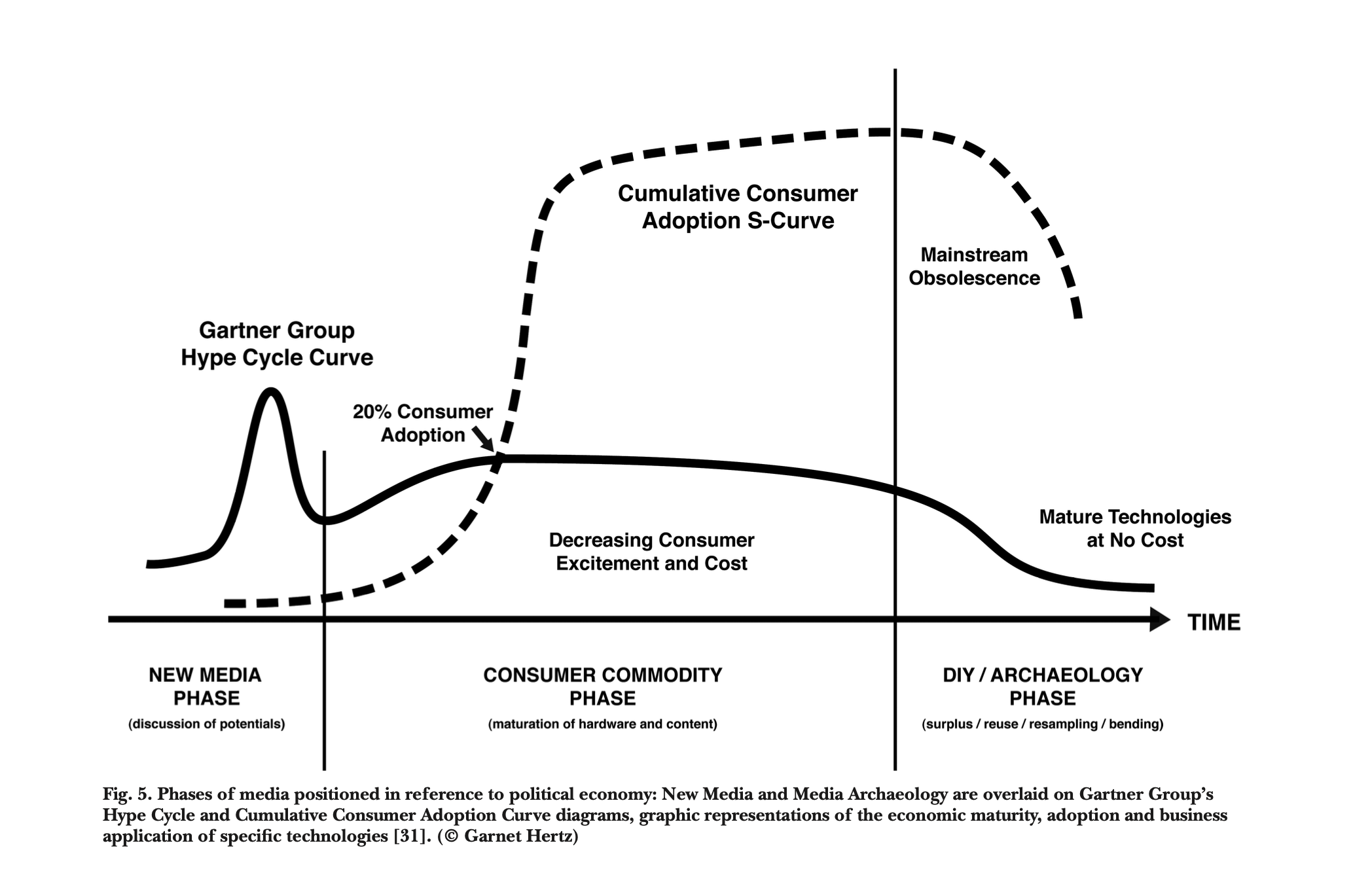
Hertz and Parikka, Fig. 5, "Phases of media positioned in reference to political economy," from "Zombie Media," Leonardo 45.5 (2012). > > Caption: Hertz and Parikka chart media's descent from hype to landfill; the DIY / archaeology phase begins where mainstream obsolescence ends. Diagram © Garnet Hertz.*
The cut, the squint, the cast
Three ways of knowing a sealed body, then. A cut: vivisection, depunctualization, my cracked screens, knowledge purchased by breaking the seal and often finding nothing sacred underneath. A squint: medieval churches cut hagioscopes, small splayed openings through internal walls, so that those barred from the chancel could watch the elevation of the host at an approved angle; the chat window and the API and the model card all read to me as squints, sanctioned sightlines into a sealed interior--mystery preserved by an architecture. And the cast: A 3D scan travels around a thing and records surface only, skin without organs, geometry with the life subtracted, a death mask rather than a dissection.
In an earlier work I collected my own little piece of latent space on a 128gb microSD card and encased it, [a home suitable for worship]; a burial, by my own definition above, and I performed it with care. BUGS saw a similar model of preservation and dissection, in the form of the NFC card and in the use of domains.
Poliks's necrolecture reaches print later this year, [speech hardening into text], and by then the piece will have undergone the very fixation it describes: verba volant, scripta manent, words fly, writing remains.
---
Sources: Disintegrator, "The Excarnated Angel" · Ernst, "The Archive as Metaphor" · Hertz & Parikka, "Zombie Media" · Arendt, The Origins of Totalitarianism · Derrida, Archive Fever · Manovich, "Database as Symbolic Form" · C. Taylor, A Secular Age · Lewitt, More Heat Than Light · Collapse OS · Hagioscope · Verba volant, scripta manent