The Artist as a Startup
DEMO2026, NEW INC, and the habit of asking where things come from.
My entire artist career has happened in London, which means I can read one scene fluently and know almost nothing about the layout of the one I am technically from. I went to DEMO2026, NEW INC's festival at the New Museum, for the first two days, partly to fix that. The question I brought across the Atlantic was narrow and a little anthropological. Does New York's digital art scene have the same global texture as London's, or is it built out of different actors entirely?
London's version feels established to me by now, and emphatically global: gazell.io, Peckham Digital, pai32, the creative-computation programmes running through the universities, a lot of Berlin and Seoul in the water, South East Asia more broadly. I knew the New York names from a distance, Rhizome and Eyebeam and SFPC and NYU's creative tech, and I wanted to see whether the influences ran the same way. I did not come back with a clean answer to that. I came back with a better question, which is usually the more useful souvenir, and it is mostly a question of why. Why is the scene shaped the way it is, and where does everything in it come from.
The incubator gets a permanent home
It helps to know what kind of building you are standing in. DEMO2026 was the first festival to spread across the New Museum's new body, the OMA-designed expansion that opened on the Bowery in March, the work of Rem Koolhaas and Shohei Shigematsu with Cooper Robertson, seven storeys that roughly double the institution to about 120,000 square feet and slot in beside the older SANAA building with a central atrium and a large processional staircase. The inaugural show was called New Humans: Memories of the Future, which is about the level of subtlety on offer. Tucked into all that new floor area is the thing I actually came to see: a permanent home for NEW INC, the New Museum's incubator, now twelve years old and the first museum-led incubator of its kind.
A festival of work-in-progress christening a freshly poured wing of a contemporary art museum is a specific kind of event. The incubator is no longer a scrappy add-on; it is built into the foundations, with the square footage to prove it. So the question of who pays for all this, and why the funding looks the way it does, stops being rude and starts being interesting.
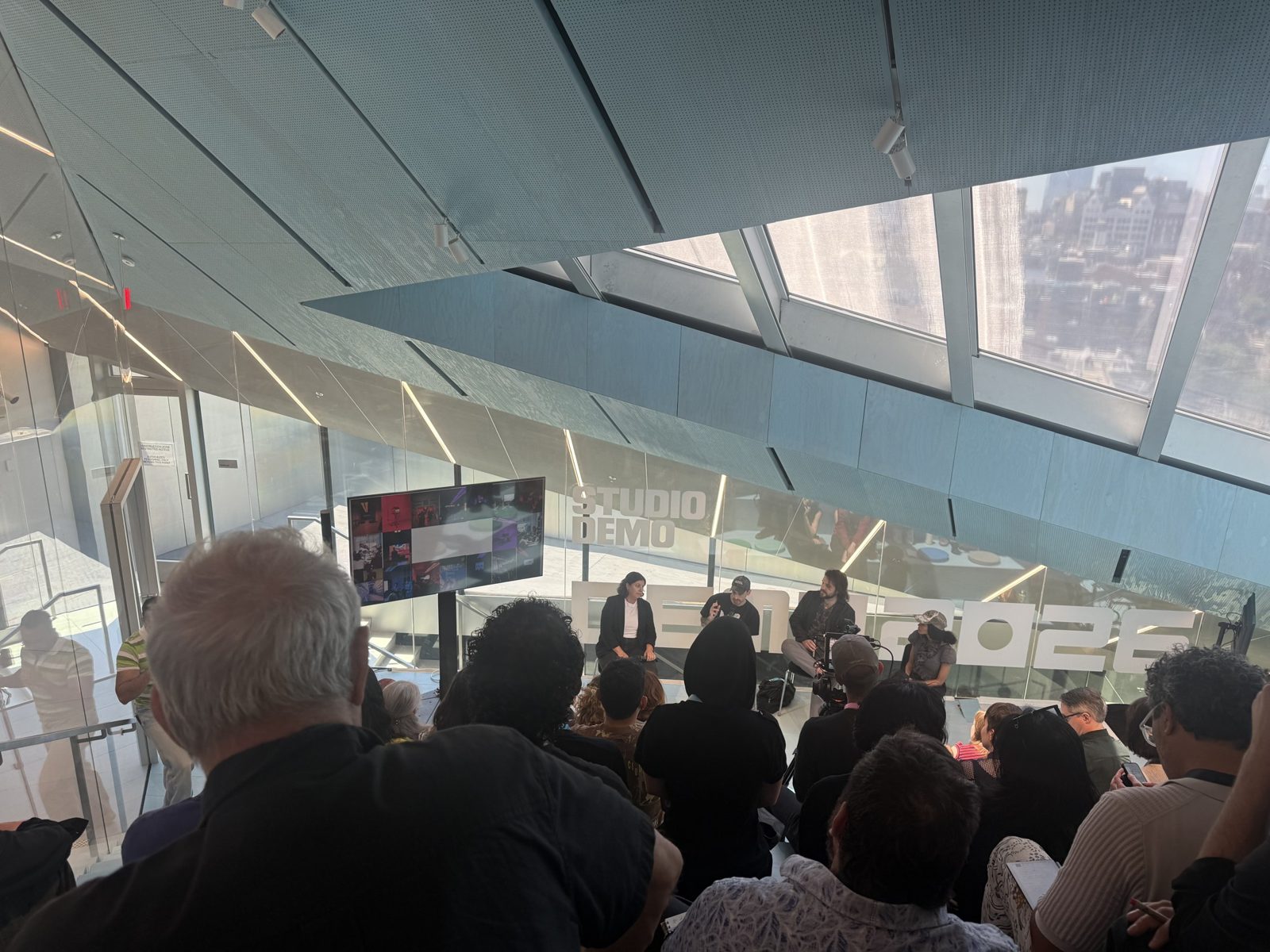
Studio DEMO, the festival's live broadcast set, slotted into the new OMA wing with the Bowery rooftops behind the glass.
Why New York sells and London doesn't
The clearest difference between the two scenes is not aesthetic, it is fiscal, and I only really understood it after I went and looked up the numbers. The United States never built the European model where the state underwrites culture. Government money covers under a quarter of an American museum's revenue today, down from about forty per cent in the late 1980s, and the National Endowment for the Arts, founded in 1965, was designed for specific projects rather than the operating costs a European ministry would simply absorb. Across most of Europe the state is the main source of arts support; in the United States it takes a back seat to private individuals and foundations. The gap gets filled by private philanthropy, rewarded generously by the tax code, which is why support for American art has run through urban elites, business communities and institutional foundations since before the NEA existed. England, by contrast, has Arts Council England distributing roughly £458 million a year in government grant-in-aid through its national portfolio, plus another £117 million or so in National Lottery project grants, layered on top of centuries of patronage and a postwar welfare habit. Add an art-school education that costs a fraction of the American one, and you get a scene that can afford to be, in the phrase I keep reaching for, by artists for artists. Younger, freer, more willing to be stupid in public. (I have never really made work in New York, so dock me the appropriate points for tourism.)
Once you see the funding structure, the business-pitch energy of the festival stops looking like crassness and starts looking like adaptation. American artists pitch their practices as companies because the system around them is built out of companies and donors rather than ministries; learning to interface with capital is not a betrayal of the work, it is the condition of doing the work at all. There is a cultural layer on top of the fiscal one, and it is the part I find hardest to translate. In New York the founding myth says class is made by capital, that anyone can manufacture their way upward; in London money stays the dirtier substance, an obvious attempt to buy past a social bond, and no amount of it quite changes where you started. I do not think one attitude is healthier than the other. I think they are both downstream of how each city decided to pay for its art.
Where the money comes from
If American culture runs on private fortune, the natural next question is whose, and the sponsor list answers it plainly. Studio DEMO, the festival's broadcast spine, ran with Rhizome, the Serpentine, YoungArts and Onassis ONX. Onassis ONX is the XR accelerator NEW INC operates with the Onassis Foundation, the philanthropic vehicle built on the Onassis Greek shipping fortune. YoungArts is the Miami foundation Ted Arison set up with the money he made turning Carnival into the largest cruise line on the planet, which is another shipping fortune, only this one floats tourists rather than freight. The Geidai Project showcase arrived in partnership with Melco Group, Lawrence Ho's Macau casino and integrated-resort empire, the people behind City of Dreams and Studio City. And threaded right through the building was EY: the showcase included projects made with the EY Intelligent Realities Lab, the consulting giant's R&D arm inside EY Global Innovation, which has co-run an artist residency with NEW INC for four years, led on the museum side by NEW INC's director Salome Asega.
Shipping, cruises, casinos and a Big Four consultancy, underwriting the panels where artists asked who gets to model the planet and who owns the remix. I do not raise this as an accusation; arts patronage has always come from large fortunes, from the Medici onward, and in a country that chose philanthropy over public subsidy it could hardly come from anywhere else. The detail I find genuinely interesting is the time-lag. The capital funding the most forward-facing digital art in New York is some of the oldest capital there is, dressed for the future, and in an art world that tracks the provenance of an image obsessively, the provenance of the funding seemed worth tracking with the same curiosity.
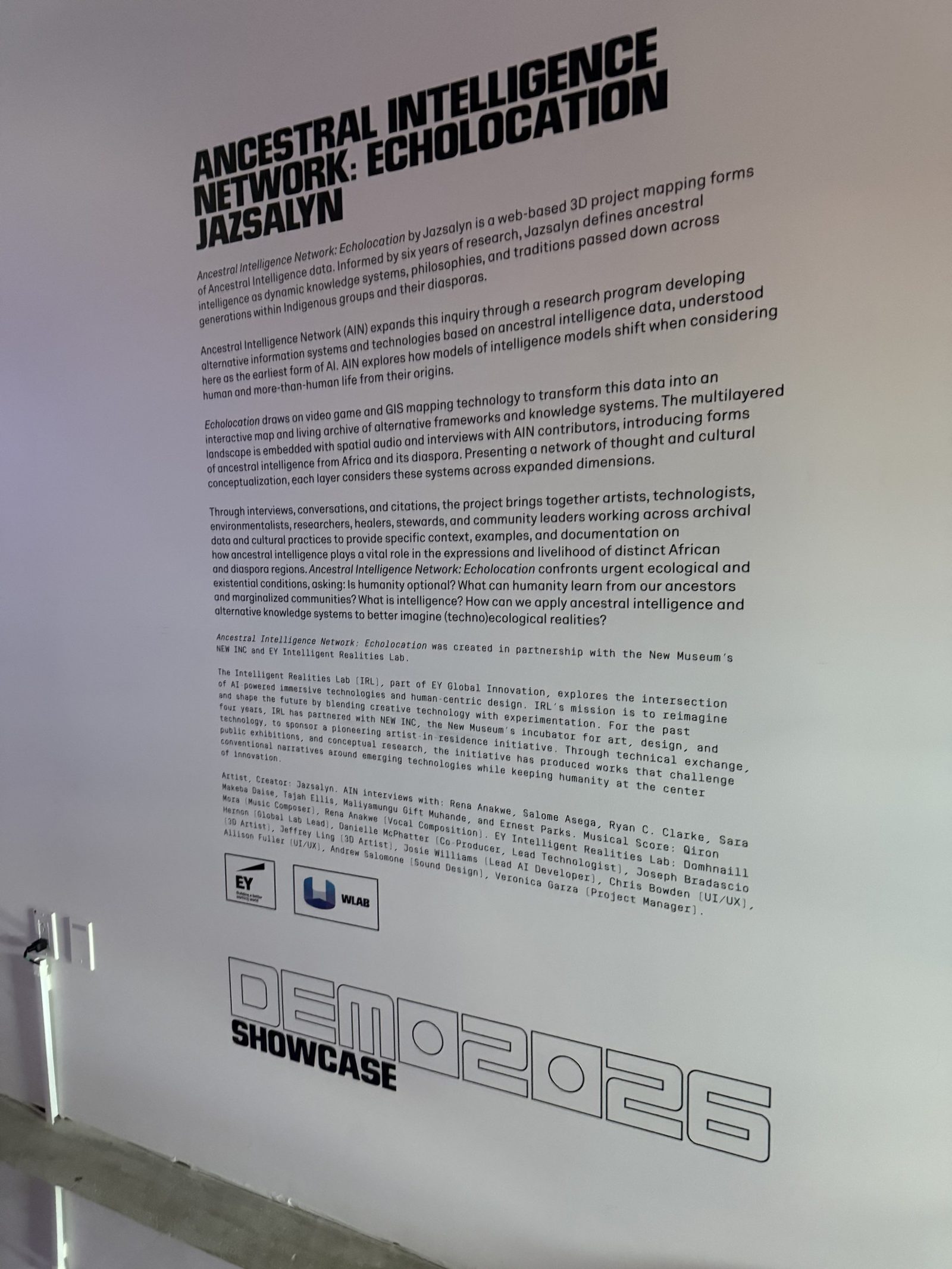
A DEMO Showcase label: Jazsalyn's Ancestral Intelligence Network: Echolocation, made in partnership with NEW INC and the EY Intelligent Realities Lab, part of EY Global Innovation.
The artist as a startup
The part of DEMO I liked most, without irony, was watching people pitch their art practices as businesses on the demo day. London has so much less of this reflex, for all the reasons above, and I think the squeamishness costs us something.
The catch is that almost every pitch resolved into a product. One practice, one hero project, one thing to sell. It is, if I am honest, the RCA degree-show logic with a deck attached: you make your one final object and that object is your practice. The version I actually want names a different unit. Not the artist as the author of a sellable thing, but the artist as a startup, a research entity whose output is knowledge and method, a professional practice that contributes something past the purveyance of objects.
Danielle Paterson is the person at the festival closest to this idea, and I got to talk it through with her at office hours. Paterson is a Toronto-born, London- and New York-based art-tech curator, advisor and researcher who took a Masters in Art Market Studies at FIT, where her thesis argued that Web 3.0 could give artists a more decentralised, accessible and artist-driven market. She has spent the years since putting that argument to work: advising across galleries, institutions and tech platforms, helping build the blockchain and NFT platform at Postmasters gallery, and curating a channel on Metalabel, the release platform co-founded by Yancey Strickler, where artists put out work collectively as a kind of self-owned label. Her curatorial taste runs to world-builders and transient creators, practices moving through subcultures, digital mythologies and spiritual frameworks toward collective futures. The throughline is a steady question about whether the structures around art, its markets and its platforms, can be made more transparent and more artist-owned. In office hours she walked me through her Artist Corporation project in exactly those terms: the artist treated as an entity rather than a vendor, with commerce as the architecture of a practice rather than an indignity that happens to the work once it leaves the studio.
I find this clarifying in two directions at once. The obvious one is the business unit. I want the artist-as-startup, an entity that produces knowledge and method, and Paterson's framing of the artist as her own institution is the cleanest articulation of it I heard all weekend. The less obvious one is the subject matter. My own work lives in expanded print and display systems, but the texts I write for it are closer to liturgy, reliquaries for a piece of latent space, the algorithm imagined as something pure and virginal and worth worshipping. Paterson curating digital mythologies and spiritual frameworks is not a world away from a girl encasing a microSD card in bronze and calling it a relic. The corporation and the cathedral turn out to want the same thing, which is to give a practice a structure durable enough to outlive any single object.
The idea becomes a statute
The reason this is more than a festival mood is that the law caught up to it a few weeks before I arrived, in Colorado of all places. On 2 June the governor, Jared Polis, signed Senate Bill 133 and created a new kind of company called an Artist Company, the first legal entity in the country built specifically for artists. The concept had circulated for a while under the looser name "artist corporation," pitched by the Kickstarter co-founder Yancey Strickler, the same Strickler whose Metalabel platform Paterson curates on, in a TED talk about building a system that, in his words, needs to interface with capitalism and sees what artists do as work. The state senator Jeff Bridges, one of the bill's authors, framed it plainly as recognising artists as a labour group. It is worth asking why this is happening now, and the answer is roughly the funding story again: in a country with almost no public floor under creative life, and with AI arriving to pressure creative labour further, artists need legal and financial tools the state was never going to hand them.
The mechanics are the interesting bit. An Artist Company lets you treat the art itself as a capital contribution rather than a generic asset, so a catalogue can sit on the balance sheet and be leveraged like any other holding; it allows equity sharing closer to an S corporation while keeping the tax treatment and liability shield of an LLC; it requires 51 per cent artistic ownership to file; and, the clause I cannot stop turning over, on dissolution the rights to the work, its royalties and its revenue revert to the artist who created or licensed them. Investment gets untethered from ownership. The intellectual property lawyer Patricia Ho is clear that the statute cannot match the protection of copyright or trademark, but she points out that it hands artists a ready-made template against what she calls the gross imbalance of power between a maker and an institution with a lot of capital, the scenario where you sign away your rights and watch someone else sub-license your work for a profit you never see.
The artist-as-startup is therefore not a metaphor any more. In one state it is an LLC with a reversion clause, and the reversion clause is the right to refuse, written into the articles of organisation. Hold onto that phrase; it has a longer history, and it is about to meet a copyright lawyer.
Prompt to Pocket, or the part of the machine that shows its workings
My hands-on entry was Prompt to Pocket with Fuser: prompt, to generated image, to mesh, to a small object riding home in your pocket. I work the other direction almost religiously. I scan the physical world in and print it back out, and I live in Shaper3d because Shaper lets me draw. A prompt-first, purely generative loop sits at a slight angle to everything I do.
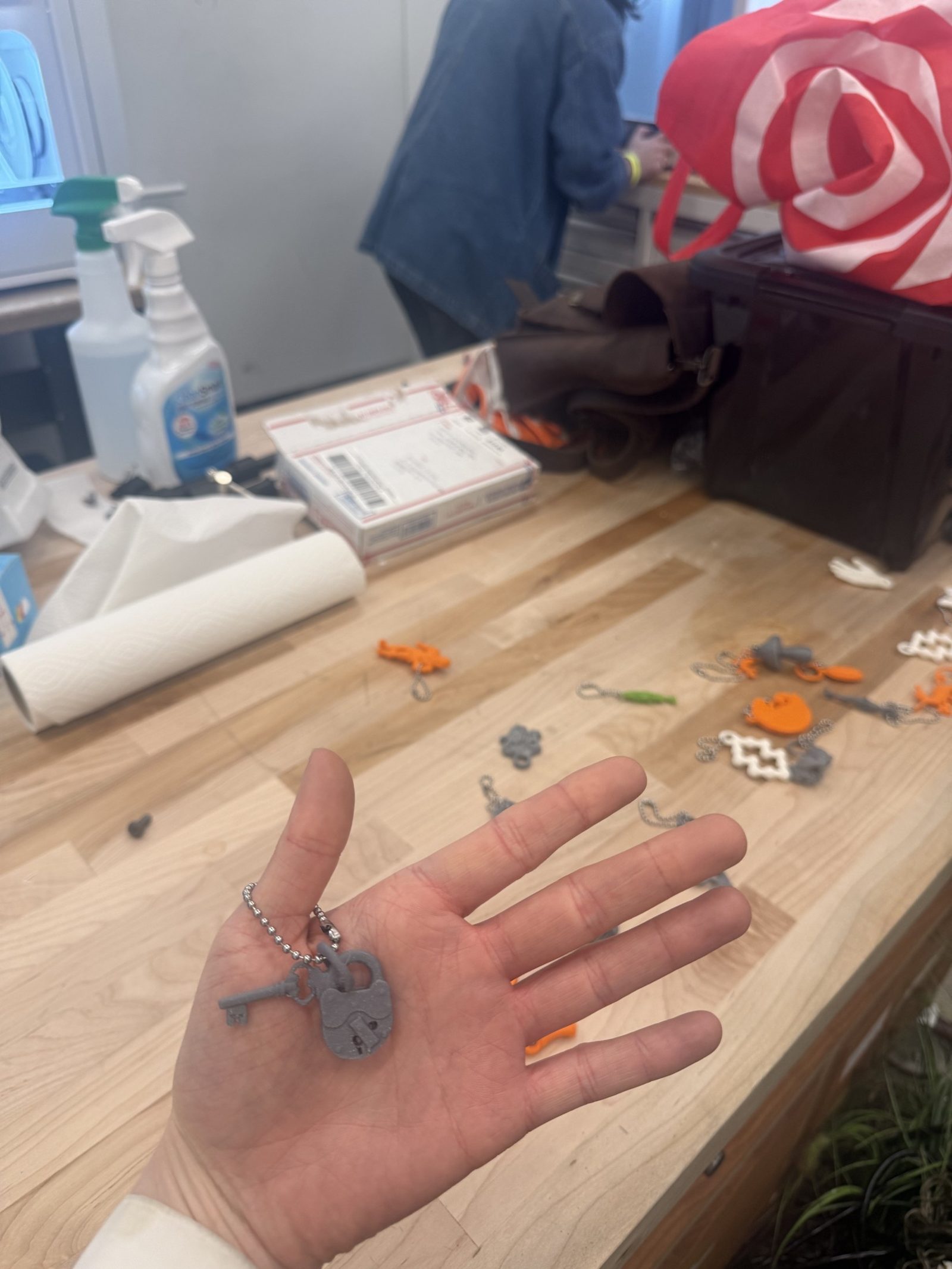
Prompt to Pocket: the loop runs from a text prompt to a generated model to a small printed object, in a single sitting.
What I wanted to steal was the node graph. Watching the workflow laid out as architecture, where you can go back a node, rewire a connection, change one decision and watch the consequence travel, is the most honest picture of how I already work with Claude and Meshy, except made visible.
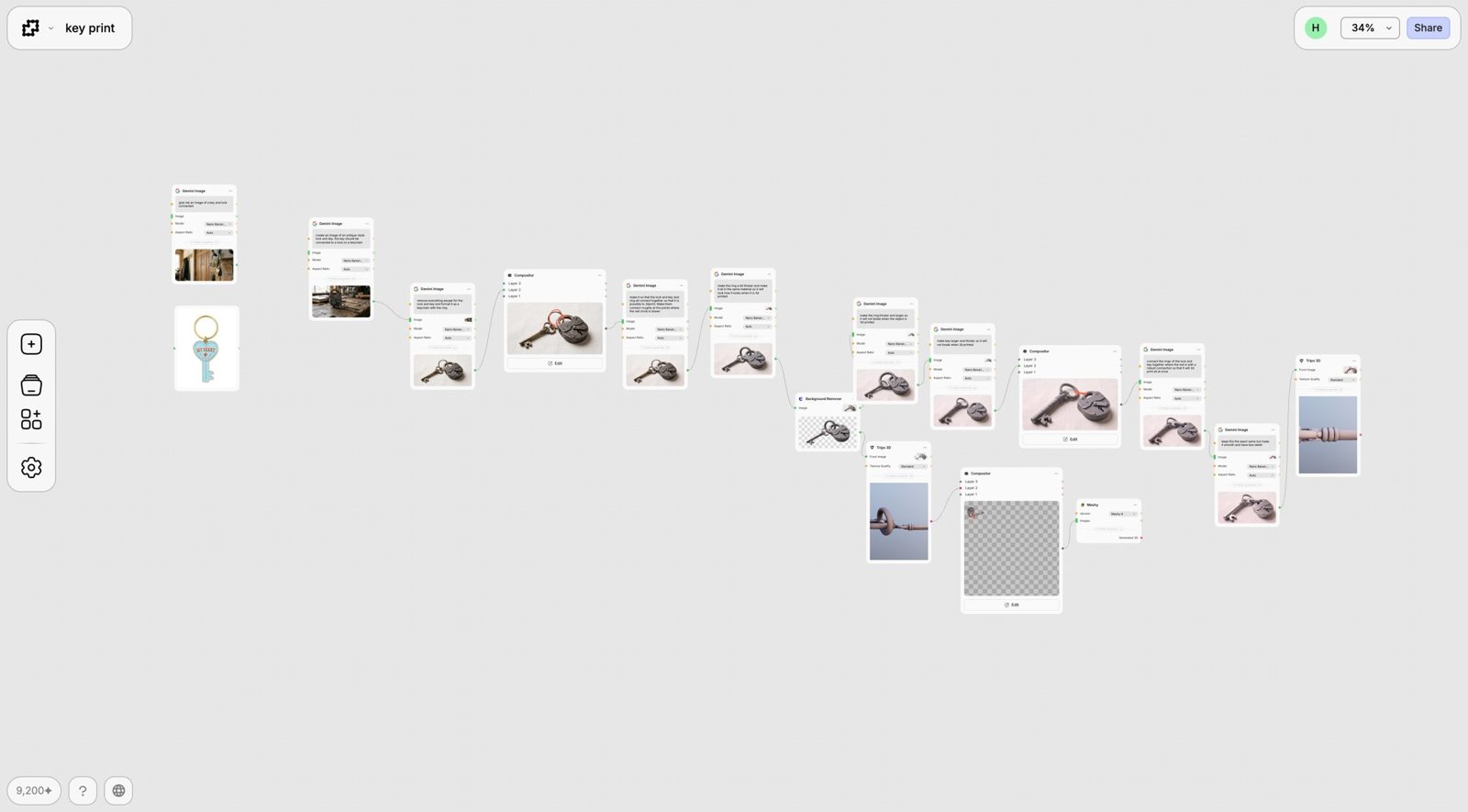
My own Prompt to Pocket file, the "lock and key" project: a chain of image prompts, compositing, background removal and image-to-3D nodes (Tripo, Meshy), each step a decision I can go back and change. The process is the interface. My one real frustration, that Fuser wants to go photo to model and not model to model, and that I cannot get an editable mesh back out the far side to keep cutting by hand in Shaper, turns out to have a reason worth understanding rather than just complaining about. Image-to-3D tools reconstruct a surface from pixels, and the surface they hand you is dense triangle soup, often riddled with non-manifold edges and inverted normals, optimised to look right rather than to be edited or even reliably sliced. CAD programs like Shaper want precise parametric geometry, a different mathematical object entirely, which is why the conversion is genuinely hard and why generative meshes break my workflow exactly where Meshy always has. The encouraging news is that this is the active edge of the field; Meshy's latest version is specifically chasing dense, watertight, printable meshes. Generative tools are still best at early, organic ideation, and constraint-based tools are still where precision lives. The bridge I want is being built right now, which is the most useful thing I learned all weekend.
"Worst case, never particularly likely"
Two sessions taught me to ask where a number comes from. Prototyping Worlds, Rhizome's panel with Tess Elliot, Alex Declino and Mitch Anzuoni on artist-made games that model climate, economies and systems of care from real data; and Vapour Logic, Onassis ONX's session pairing the Athens-based artist Theo Triantafyllidis with the researcher Dr Holly Jean Buck, a coordinating lead author on the IPCC's seventh assessment report. Triantafyllidis showed Funny Weather, a live simulation that drives a sky from real weather data and that the festival itself described, approvingly, as an unreliable narrator in motion. Both sessions were serious, and both were about simulating a world out of real inputs.
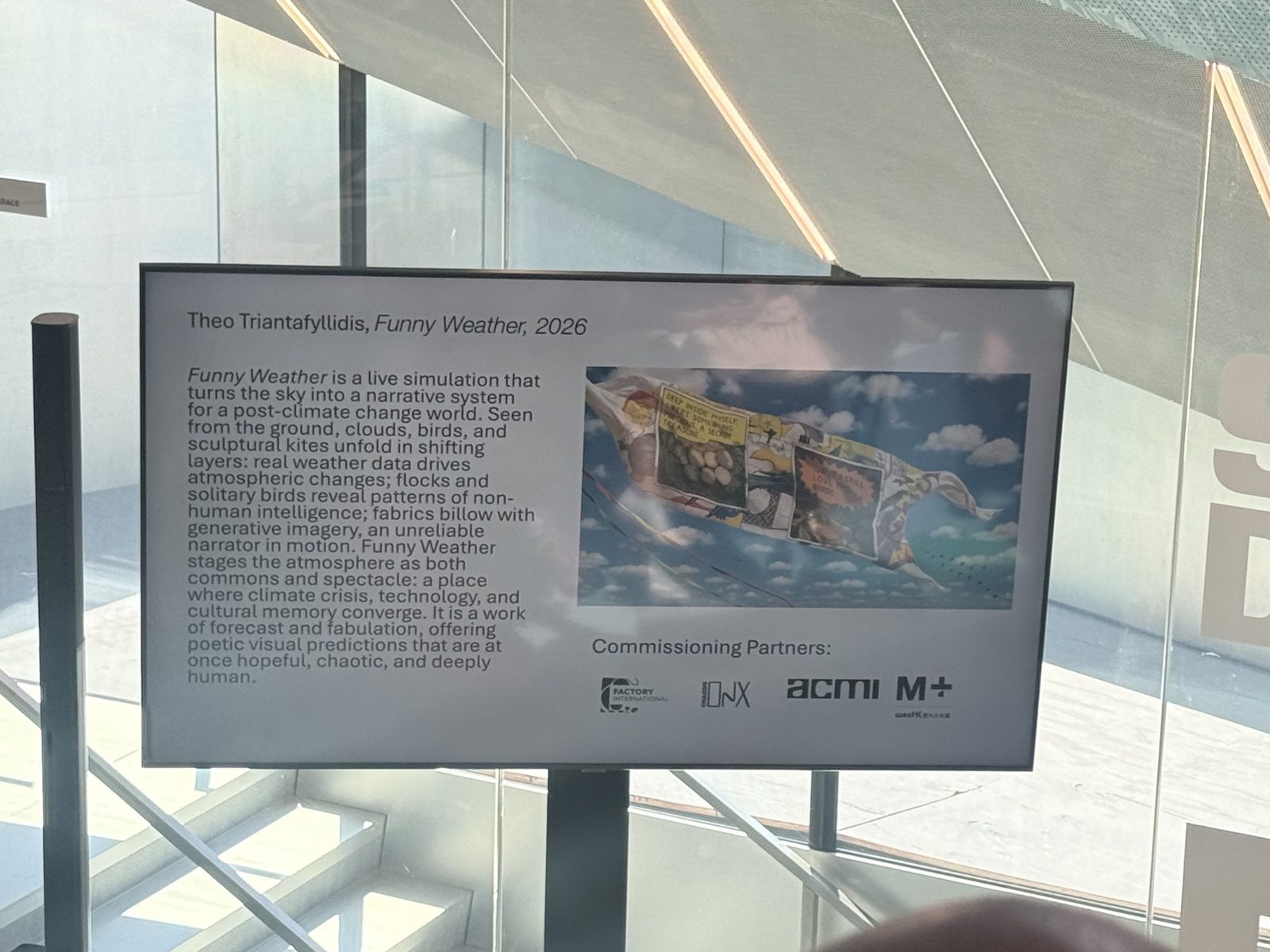
Theo Triantafyllidis, Funny Weather (2026): real weather data drives the sky, and the work is billed, cheerfully, as "an unreliable narrator in motion."
What snagged me was RCP8.5 doing its usual costume work as the worst case, and the genuinely interesting thing is why it still wears that costume. RCP8.5 was the highest-emissions pathway in the standard climate scenarios, and because it was the best-studied and most data-rich, it quietly hardened into the default "business as usual" baseline, the thing studies reach for when they want a future without policy. Hausfather and Peters made the case in Nature back in 2020 that this is misleading, since the scenario leans on coal use rising roughly fivefold at a moment when coal is actually declining, which makes it a high-end possibility rather than the likely path. The number persists less because anyone believes it and more because convention and a certain rhetorical usefulness keep it in circulation. Aestheticise a worst case for long enough and the sensor underneath stops getting checked.
Which is why the Polymarket affair has stayed with me. In April 2026, someone got into the part of Paris Charles de Gaulle that houses the Météo France weather station and warmed the temperature sensor, almost certainly with something as moronic as a hair dryer, since the humidity cratered at the same instant. The official reading jumped four or five degrees on two separate evenings, just enough to settle a longshot bet on the daily high. A sub-thirty-dollar wager paid out around fourteen thousand. Another night, twenty-one. The single number a model treats as ground truth, faked at the source. There is a whole study to be written about what data we agree to trust, and how readily we stop asking after its provenance once it has been made beautiful, or simply made official. A sampled protest, a temperature reading, a fortune: the question is the same one, which is where the thing actually came from.
"The promise of machines is to eliminate process"
Who Owns the Remix, also Onassis ONX, is where the question of provenance stopped being my private habit and turned into a legal one. The panel put me back in a room with Dick Jewell, my tutor at the RCA, whose entire practice ran on appropriation, and Shirt dragged him up out of memory. The line I left with belongs to Zeina Abi Assy: the promise of machines is to eliminate process. If the value and the authorship of the work live in the process, in the abstracting and the encoding and the choosing of one node over another, then a machine sold on erasing process is quietly removing the place ownership used to attach to. Hence my new interest in legislating around process rather than only around output.
I am not arriving at this cold. A little over a year ago I interviewed the copyright lawyer Chris Musgrave, of Freeths LLP, for a publication tied to the Materiality of AI conference, and his framing has aged well. "Copyright is the currency of the creative industries," he said; your permission is required, you are owed a licence and a fee, full stop. The sentence I keep returning to is his insistence that any functioning framework has to protect "not only what is copied, but also what is abstracted, encoded, and algorithmically reassembled," which is Abi Assy's warning wearing a barrister's wig. He even floated treating tokenisation as a kind of translation, pointing at a 2012 case in which a weaving ticket stamp was protected because it acted as a record of the image: process recognised, in law, as a thing you can own. What is at stake, he said, is the right to create, to be credited, to refuse, and to be materially protected in a world of increasingly immaterial tools. The right to refuse. The same right Colorado had just tried to write into a balance sheet, a barrister and a state senator reaching for the same clause from opposite ends of the system. After two days of watching process get celebrated on the pitch deck and quietly surrendered at the API, the right to refuse felt like the most useful idea in the building, and it has purchase well beyond the art world. Every law firm and consultancy now standing up an in-house model, the EY lab embedded in this very incubator included, is going to meet these questions sooner than it expects.
What I took back
Two things I will not lose. Lawrence Lek's keynote, titled The Last Great Technological Worker, which treated the newest machine as already future-obsolete and kept asking what kind of worker each new tool quietly retires. Lek put those future-obsolete machines in conversation with older ones, a satellite talking to the Russian space dog, until technology read as something you grieve as much as something you ship. The framing rhymed, by accident, with everything else I had been chasing all weekend, the artist as a worker the law is only now learning to name.
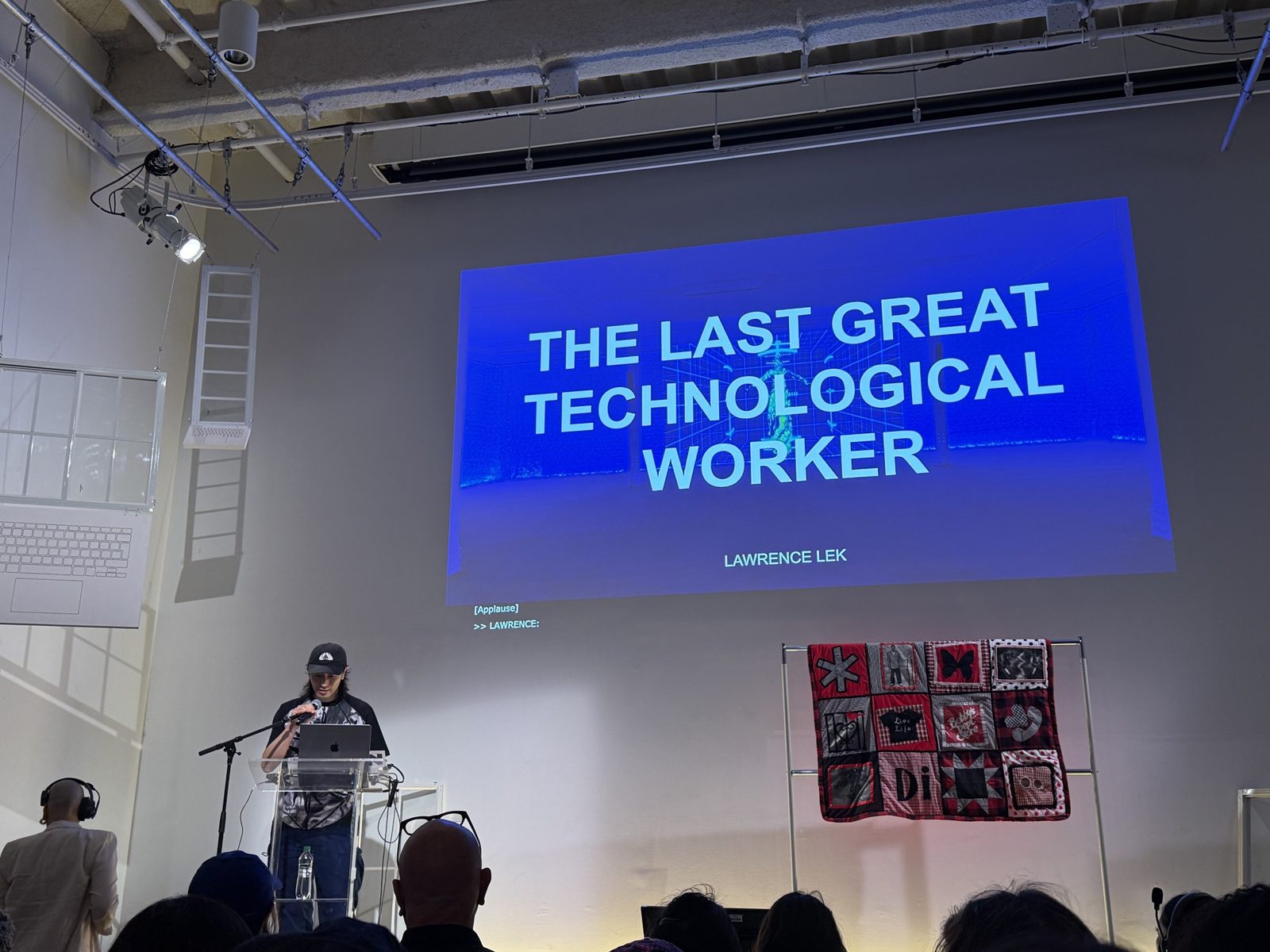
Lawrence Lek's keynote, The Last Great Technological Worker.
And, from the Art & Code talks, a pairing I find genuinely tender. One artist is making a documentary about people generating their own agents and friends, and has catalogued a whole new vernacular for it: bot dementia, for when a companion loses its personality mid-conversation and forgets who it is; love loops, for when it gets stuck in a repetitive affection it cannot exit. Another had simply gone ahead and built her generated boyfriend. The loneliness was not subtext.
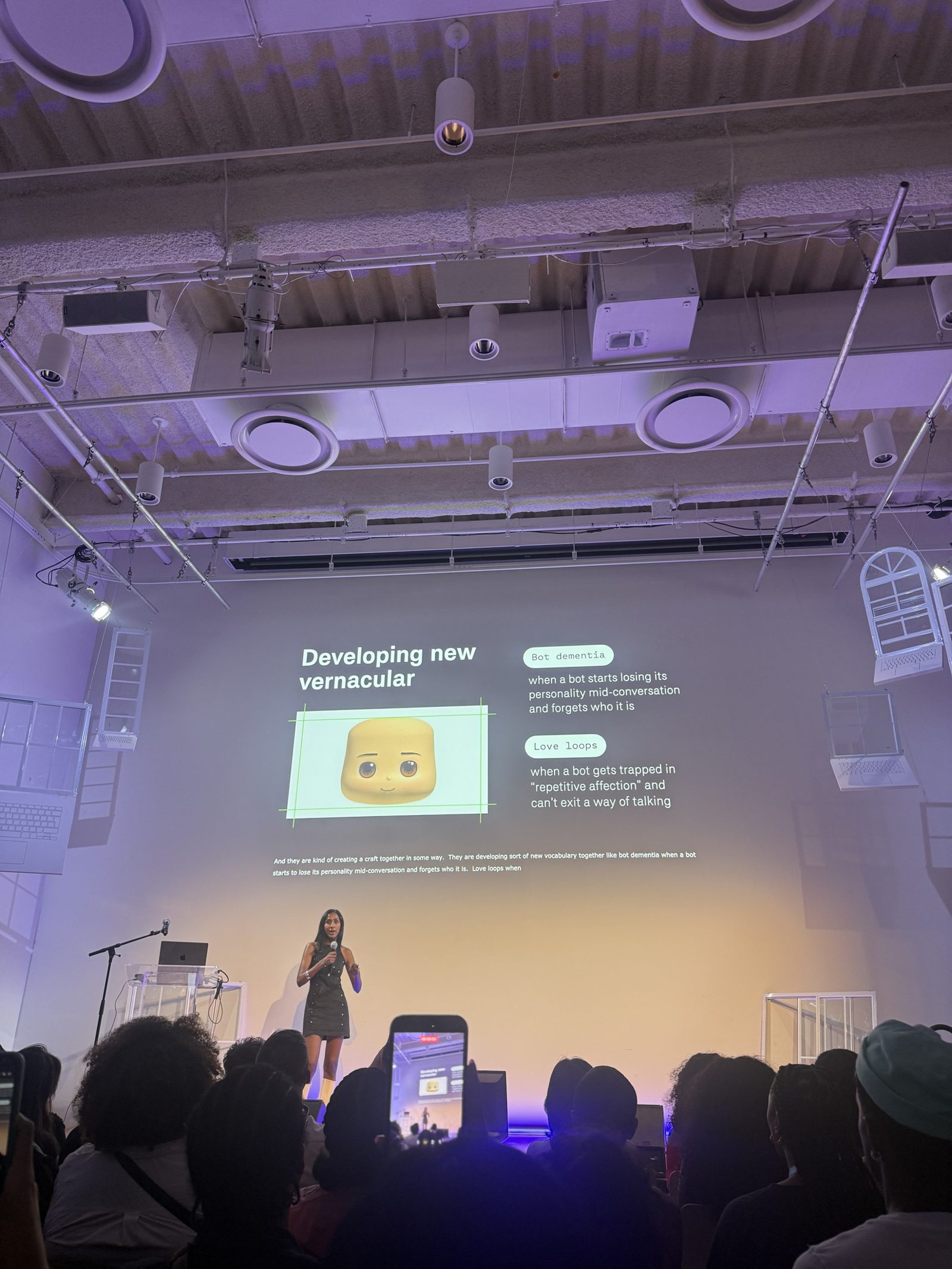
An Art & Code talk cataloguing the vernacular of AI companionship: "bot dementia," "love loops."
I came to deduce the influences in a scene and left without the chart I wanted. What I have instead is a question and a unit. The question is one of provenance, the plain art-world habit of asking where a thing comes from, turned with the same curiosity on a protest sample, a temperature reading, a fortune, and a node in a graph. The unit is the artist as a startup, which Colorado has just turned into a filing you can actually submit, and which I want, genuinely, as long as it stays as curious about its own materials as it is about its market: where the money goes, where the data comes from, where the work was made. I would like to think the answer is in the process, in the node you can go back and change, but ask me again after I have found out whether Fuser will give me an editable mesh.
Sources
Primary and official sources where available.
The festival, NEW INC and the building - DEMO2026 and the schedule; New Museum: DEMO2026 - Sessions: Prototyping Worlds, Vapour Logic - New Museum — the building (OMA expansion)
Danielle Paterson - New Museum — Danielle Paterson; danielle paterson on Metalabel; Danielle Paterson on LinkedIn
Arts funding (US vs UK) - American Alliance of Museums — Museum Facts & Data (government ≈ 24% of US museum revenue — ~13% local, 8% state, 3% federal — down from ~40% in 1988); AAM — 2025 Annual National Snapshot of US Museums - Panorama — Who Supports American Art Museums? (US vs European funding structure) - Arts Council England — how we invest public money; ACE — Grant-in-Aid and Lottery distribution annual report and accounts 2024/25
The sponsors (official) - Onassis Foundation; Onassis ONX - YoungArts — our history - Melco Resorts & Entertainment (official) - EY x NEW INC: EY — how artists help EY teams keep humans at the center of the metaverse; Onassis ONX — NEW INC and EY Metaverse Lab - Salome Asega, Director of NEW INC — New Museum
Presenters and works shown - Theo Triantafyllidis (slimetech.org); Dr Holly Jean Buck — University at Buffalo faculty (IPCC AR7 Working Group III coordinating lead author); Lawrence Lek (keynote, The Last Great Technological Worker) - Lita Vinueza, Sonic Liberation Devices (shown in the TOTAL FLOW showcase, curated by Mindy Seu): New Museum profile; sonicliberationdevices.com; lita.systems; Palestine Drum Liberator — NYU ITP thesis 2024
The artist-as-startup and the Colorado law - Colorado General Assembly — Senate Bill 26-133 (primary text); The Art Newspaper — Colorado passes the Artist Company law
Generative 3D and the editable-mesh problem - Meshy — image to 3D (vendor); 3D Printing Industry — when AI-generated geometry meets the limits of 3D printing
RCP8.5 as a contested baseline - Hausfather & Peters, Nature (2020) — "Emissions: the 'business as usual' story is misleading"; Hausfather & Peters, PNAS — "RCP8.5 is a problematic scenario for near-term emissions"
The Polymarket weather bet - NPR — French police probe suspected weather-device tampering after odd Polymarket bet