Philip Beesley @ RCA
Immediate takeaways -
I latched onto the way Philip weaves unhidden digital infrastructure within his work, using it, I perceive, as a material. I am interested 1. In the relationship here to his concept of apoiesis (apoiesis he defines as artlessness, but also poiesis and latin potere, potestas – strength/power). And 2. in understanding how his notions of precarity relate to the creation of installations as an art form and their fundamental ephemerality.
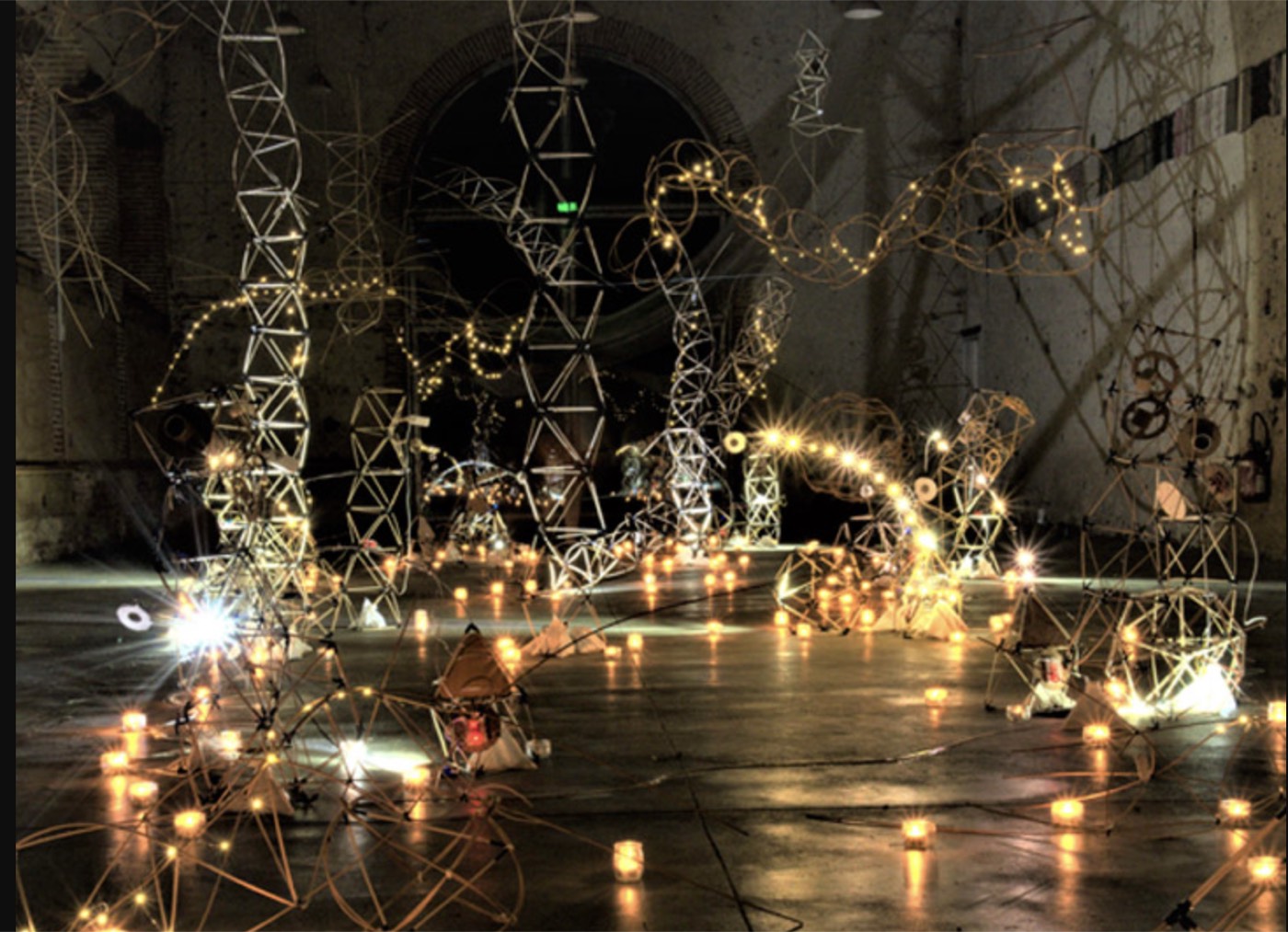
I wonder if there is some analysis to be made of his use of materials through the lens of arte povera? In the manner of how the movement uses materials to critique systems, and moreover in how the movement advocates that materials be left bare, that they speak for themselves and (most of all!) that these materials have something to say.
I am very interested in Philip’s discussion of apoiesis as a sort of artlessness, and I also see a really interesting connection between this and a sort of power or - I suppose in this terminology - powerlessness – greek poiesis (to do or to make) relationship with latin potere (to be able to do) and potestas (power).
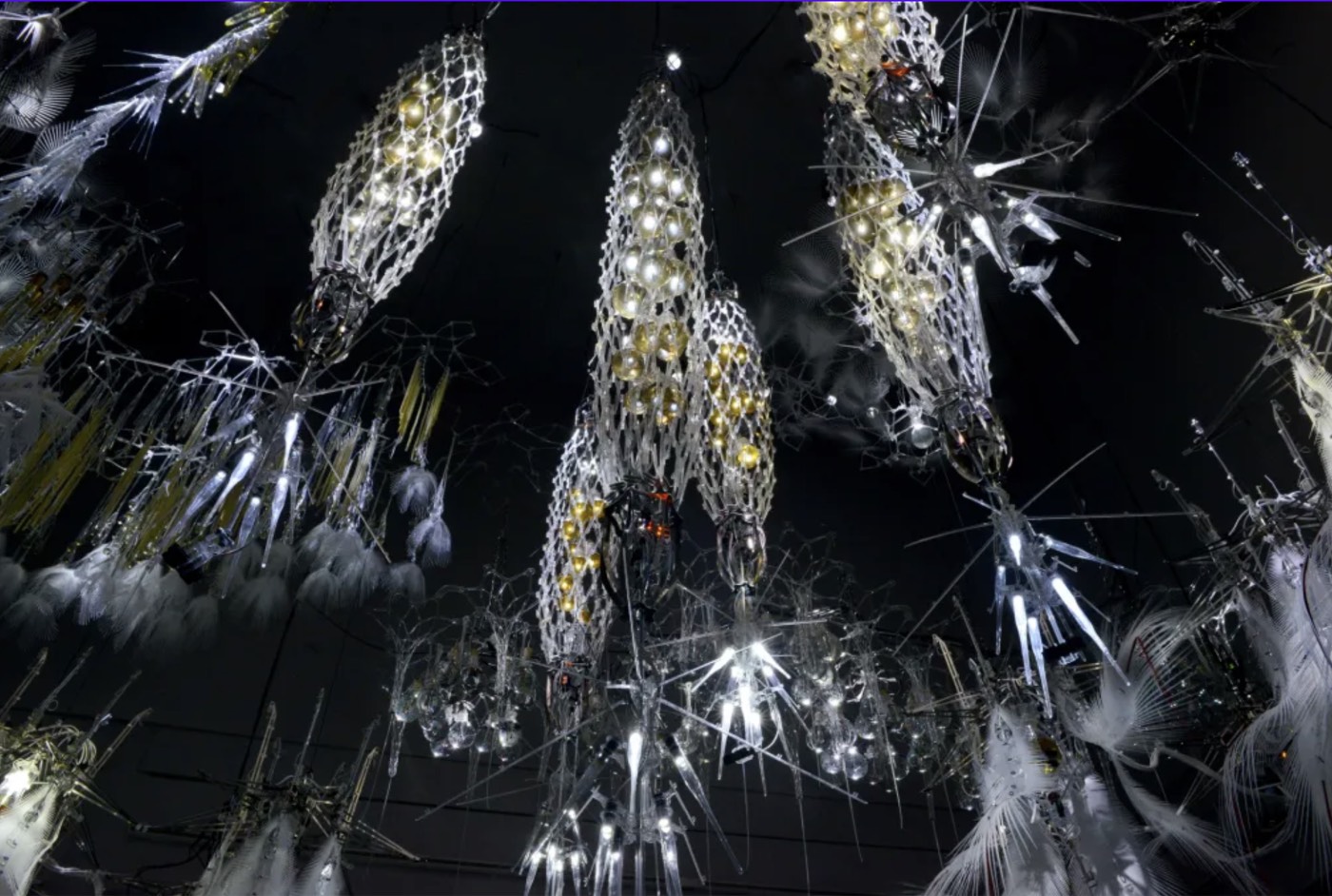
I am wondering how this idea apoiesis connects to his choice and use of materials.
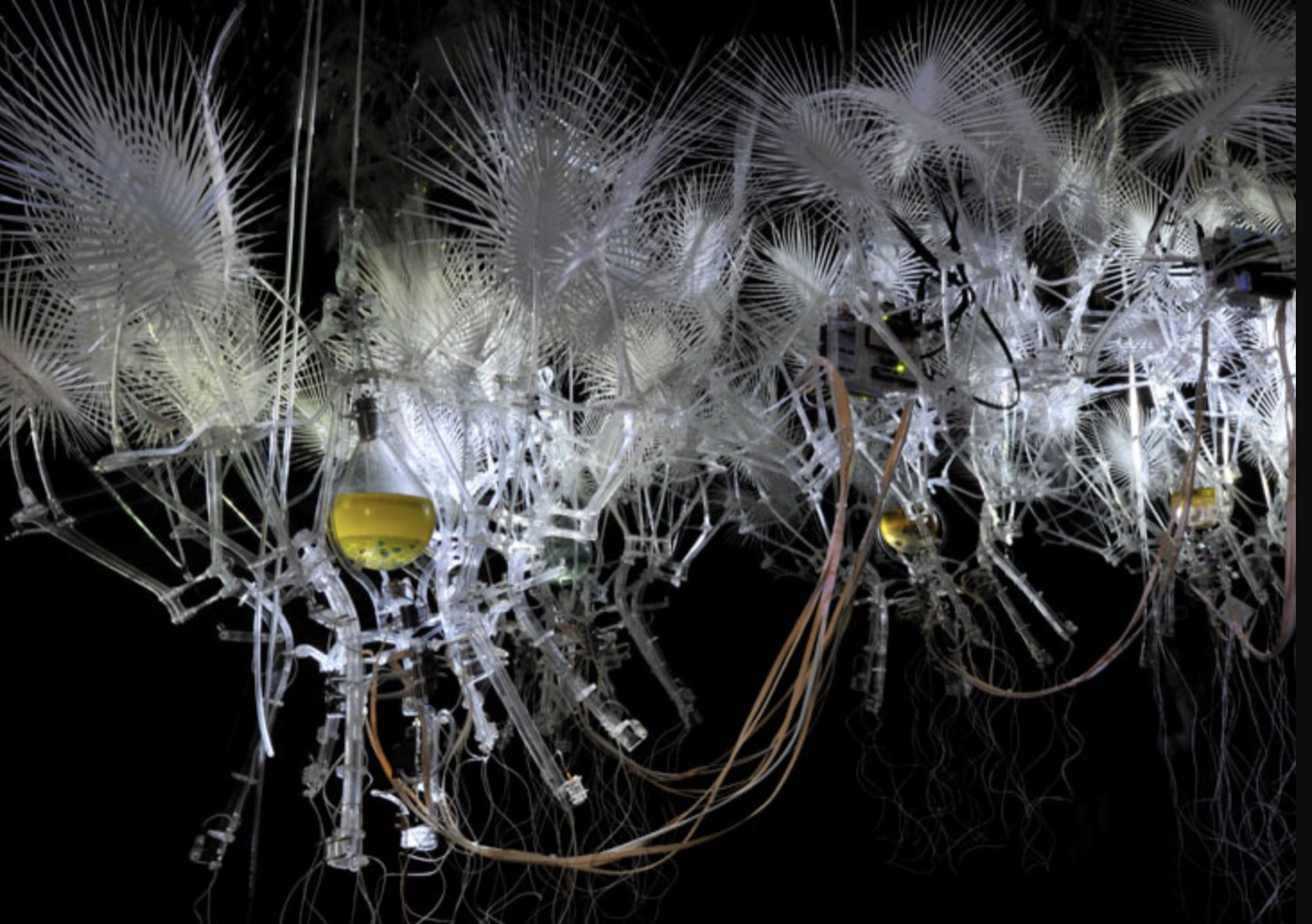
I am amazed by his use of digital infrastructure as an artistic material – for instance, in hylozoic ground, the presence (or not just presence) but even centering of wires and sensors makes them into almost an artistic medium – it seems that he’s uplifting these digital components, which others might hide - as being sorts of objects of utility - up almost to the status of oil paint or marble or bronze…
I am also curious how this use of materiality relates to Philip’s discussion of precarity… What is the artist’s relationship to the ephemerality of the work? I am assuming that most of the installations are not permanent… Philip spoke about the importance of finding something that is deeply resilient but he also juxtaposed this with the idea of precarity and that relationship with iteration. I wonder if Philip finds it difficult to navigate this precariousness and its evanescence? If he ever finds himself attempting to memorialize his work - to make something that maybe someone can hang on their wall, something that doesn’t persevere as solely a photograph or video?
Reflecting a couple days later --
I was so excited to hear Philip discuss the idea of the kit as a way of extending an installation to a wider community (not to mention as a way of making an installation-based practice into something even moderately lucrative, a concept about which - as many have been kind enough to notify me of late - I must begin to think...). I have thought a lot about how someone else might assemble one of my apparati - with instructions or without. I think they would have some difficulty with the magnets. At dinner we also discussed the idea of creating work from work - I understood him to mean deriving sellable work from installations; I connected with him on this idea of the iterative process quite deeply; all of my work is iterative.
Philip agreed that I should have covered Apparatus II completely. This made me firmer in my resolve to credit in my complete and utter infallibility (especially) when it comes to my own work.
Maybe someday I will get a degree in architecture. Perhaps I'll finally learn how to draw.
NOTES -
“via negativa”
“Artlessness” “Apoiesis” “artlessness”
Poiein gr. to make // latin to rule
“A-material → pictorial → perspectival”
Annunciation (caparelli)
Summa Theologica - via negativa “sacrifice of our own will, art must be artless”
“Is it possible to create a space of projection where we can feel we are projecting”
Hylozoic (hylozoic ground”
Shape memory alloy
Actuators
“Swamp-like” – public exchange
Each individual element fragile/vulnerable/susceptible to tangling
“It’s not necessary to make a subway system “ – spectrum of care
False dichotomy of infrastructural things and unstable natures
Strength and belief in resonance and stability of the materials
Deliberate vulnerability // static exchange
“Architectonics” - king of the builders
Laser-cutting of opposing slits
Laser cut zinc
“Things start hot and go to cole” - second law of thermodynamics – entropy increases
Order as beginning and disorder at end
Priogine, Nobel 1977:energy / passing through
Things fall apart: only true for a closed universe
Open universe – ORDER CONSTANTLY ACCUMULATES
“Some degree of shell making and shelter is necessary”
Pantheon: absolute projection”
Ugliness of a tradition of closure – vir virtue – vitruvian man
New physics: standing waves, emergence, sheer fertility of flux
Shellmaking
LEXICAL ASSEMBLIES / LEXICONS → COMPOUNDING AND SHARING
DEVELOPING INTO KITS
Precarity
Semi-collapsing / resounding
“Many cycles needed in order to find coherence’
Quasiperiodic
Pembroase tesselation
Oscillation: way of making harmonic and resilient materials
Studio-developed software: tracing,
Pareidolia - παρα ἐιδος
THOU SHALT NOT WORSHIP FALSE IDOLS
Iris van herpen
Shadow work
Digital twin
“The opposite of the uncanny valley”
Hylozoic ground:
Microcontrollers
Protocell making / mixing
Collab with rachel armstrong
Rob Gorbet
Bladder works engorged with salt
Scent grounds
Shimmering vibrations
Aria:
Participation
Laser-cut steel (stainless) and renewable aluminum
Resilient and permanent work
Participatory work - made touchable
Capacitor sensing - alluminized cover whereby touching could be shimmering motion
Grove: at venice biennale 2021-22
Ll design turned into digital twin, then shot as film
48 channel spatial sound network
LIVING SHADOWS
Shadow as sheltered space where light is going slow, glacial nature of shadow ‘
PATAPHYSICS
Adapting a kit - a kit as a way of your work traveling beyond itself