Total Flow @ NEW INC
Total Flow at NEW INC, the protocol of systems art.
The first thing I noticed about Total Flow had everything to do with the racking. Sofia Figueroa staged the whole showcase on clear vitrines and modular aluminium scaffolding, so that every piece sits half-built and wired and exposed and cables looping out across the floor. I spent a while looking at the scaffolding before I looked at any of the art, perhaps the correct order of operations.
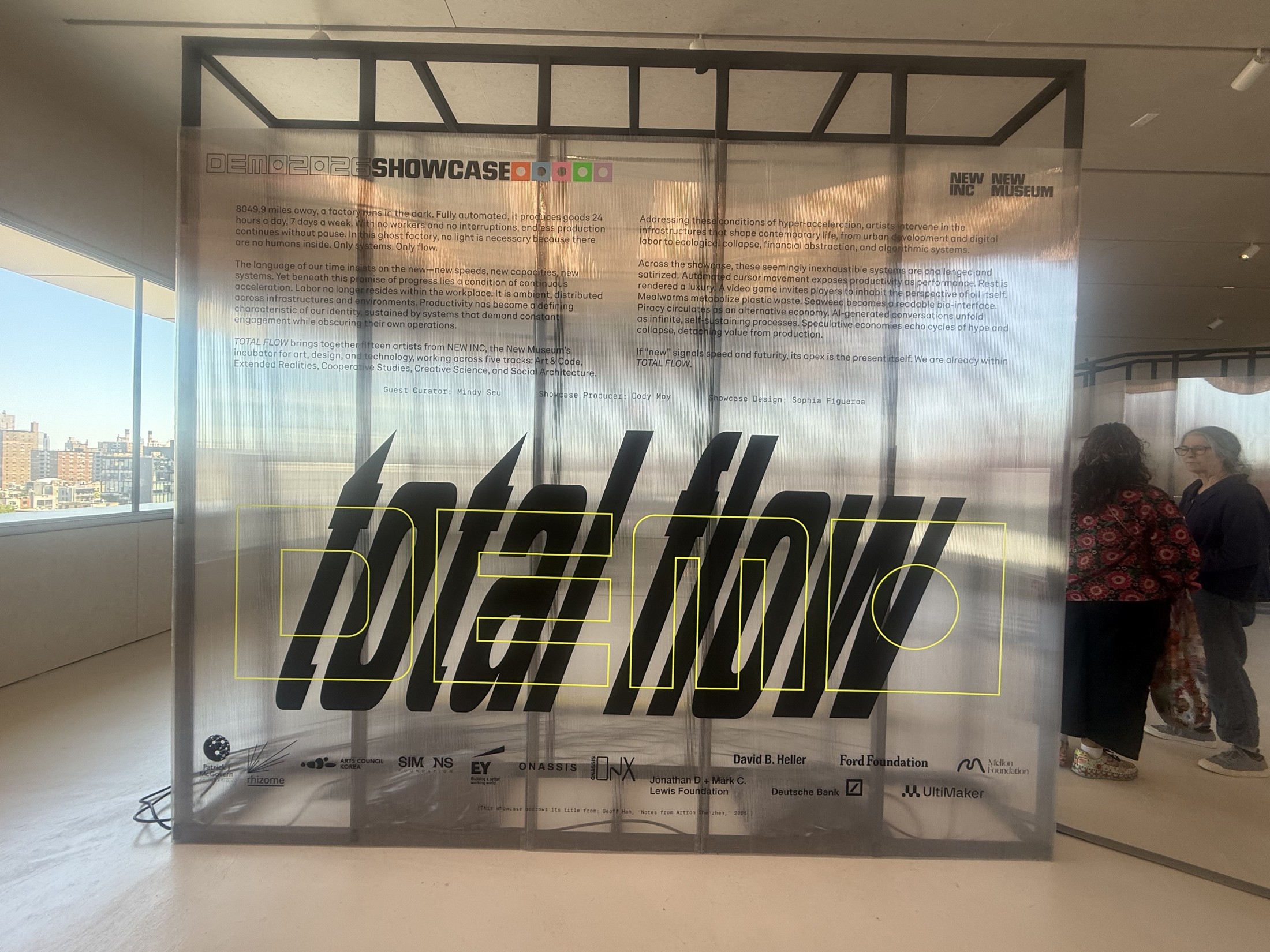
Total Flow's title, rendered in wireframe up in the new New Museum's Sky Rooms.
Total Flow gathers the Year 12 NEW INC cohort, curated by Mindy Seu, whose Cyberfeminism Index reads as a kind of network made legible. Fifteen artists, no shared style, and the question any group show in 2026 has to answer: what binds a cohort now that no salon or academy issues a house style any more? (Something binds this one, ofc, because NEW INC functions as a school of a different kind. The New Museum founded it in 2014 as the first museum-led incubator (no relation, despite the names, to the New School downtown), but an incubator holds its members the way no salon did, through a year of shared membership, a shared floor, and a shared showcase rather than a shared manner. Whatever house style still circulates comes less from academy than from algorithm, the feed and the model training a generational eye on the same references until the look goes ambient, decided by nobody and absorbed by everybody. (I have tried to define aesthetic movements before, mostly I have embarrassed myself; the urge to brand belongs to critics I think, while movements, when they arrive, probably arrive from artists, or Peggy Gugg.) I guess maybe this lack of academy / house style could account for the consistent creep of systems architecture in shows (of which I am by no means innocent): scaffolding motifs unite otherwise-disparate works. The scaena needs to be the unifying factor because there is none, otherwise. God Bless Curators.
Systems art got its name back this spring
The discourse handed me a frame a couple weeks before I walked in. In May, Emily Watlington argued in Art in America that the biggest art trend of the century names not a style but a mode: systems art, the term Jack Burnham coined in Artforum in 1968 for work that had stopped making objects and started running processes, cybernetic, real-time, plugged into their context. Hans Haacke bridges the decades; a Perspex box of condensation one year, the slumlord holdings of a Guggenheim board member the next, art understood, in Burnham's words, not as a thing but as "relations between people and components of their environment." Watlington draws a distinction worth borrowing. The strongest systems art, she writes, behaves as a mechanic, lifting the hood and getting grease on its hands; the weakest minds the car wash, making the machine gleam. "You can, in fact, make the invisible too visual," she warns, and the deeper danger follows from there: "in trying to visualise a system, an artist can end up reproducing its logic, prioritizing scale and efficiency over meaning, over anything human."
Total Flow declares itself a systems-art show, not subtly; the title states the thesis. Flux isn't so far off. A room full of works wired open on scaffolding insists that the flow makes the work and the apparatus holds the point.
The apparatus does the work
I came to this predisposed, which I should admit again. I spent most of last year obsessed with scaffolding, and specifically with the tarpaulin lashed around it, the way a construction site wraps its own exposed structure in a skin that hides the work while it simultaneously advertises it. The scaff + exposed wiring pulled to mind the work of Sam Lewitt, whose practice materialises the hidden flows of a building, the heating circuits, the rerouted electrical grid. Its sort of taking a knife to the belly of the gallery wall and spilling its guts; I went to Frieze last year and only took pictures of the plugs. Lewitt and Haacke do what the scaffolding does, as content rather than furniture; they materialise the apparatus. Lewitt came up through the Whitney Independent Study Program, (rip?) the critical-theory programme that has drilled institutional critique since Haacke's generation. Maura Brewer, another ISP graduate, pursues the same territory through finance: her essay-videos walk you through laundering money and the financialisation of art, laid out almost like a how-to. Against the isp pedigree, NEW INC reads differently; it incubates art and technology, and gives its members a desk and a network rather than a seminar in critique. A distinction starts to suggest itself, but I think maybe it's loose: the Whitney programme has tended to produce systems artists, who turn the institution's hidden machinery into their subject, while the New Museum's incubator tends toward protocol artists, who make the working thing and let the apparatus carry the argument. You can even read it in the kind of wire each artist exposes. Lewitt opens up the electrical, the building's hidden current; Tess Oldfield's pipes, later in the room, open up the pneumatic, air and breath and the body. One lays bare the institution; the other lays bare the artist, or the work itself. (Still unsure whether exposing the wires reads as honesty, or whether "wires out" has just become a new white cube lab-chic motif that lends any work the look of rigour because it looks technical. This question is more for myself than anyone else -- I'm never sure whether I'm being clever or just lazy.
Born hybrid, became hybrid
Walking the show I found myself sorting the works between the ones born hybrid, built in and of the technology, and the ones that became hybrid, good work with a screen bolted on. The distinction is kind of formed in my mind through Michael Fried, and his 1967 essay wherein he named a certain contemporary aesthetic form of theatricality, the quality he distrusted in art that needed an observer in the room. "Art degenerates as it approaches the condition of theatre," he wrote, preferring the self-contained painting that asked nothing of your presence. Fried lost that argument; theatrical, durational art, the kind that wants a body in the seat, now fills the water we swim in. Born-hybrid work stays theatrical in his sense, a system or a performance, alive, real-time, incomplete without body. Became-hybrid work keeps to the absorptive kind, finished in itself, a thing you stand and watch.
Adam Vačkář's What Becomes a Monster sits, for me, on the became side, and I say that with affection. It unfolds as a research film about giant hogweed, the Victorian ornamental turned state enemy, in which Vačkář reframes the war on invasive species as a colonial reflex, the plant as maligned migrant. I liked it a great deal. It also did not need the festival; a strong ecological essay that happened to screen at a tech show, a representation of its subject rather than a live system.
Interactive theatre, and who writes the characters
If this art plays as theatre, somebody writes the characters. Aurora Mititelu does it most literally; her Abel & I gives you an AI companion, a boyfriend named Abel you text on a device that answers in a thread styled to read as WhatsApp. The interactivity stays basic, message in, message out, but the move does not, because she scripts a character and hands you a role, and you perform your half of a relationship with something written for you. Yaloo (Ji Yeon Lim) writes a character too, except hers plays her own grandmother, mapped and rebuilt as an aquatic avatar in funky outfits, swimming through a kitsch transhuman aquarium thrown partly onto LED fan holograms, that spinning mall-and-nightclub display tech that hangs an image in the air. (I had seen the LED fan before, at the 2024 Venice Biennale, in Guerreiro do Divino Amor's Swiss Pavilion, the one reviewers called deep-fried in vaporwave, with its rotating mother-goddess and its lasers. A lineage runs here maybe, the matriarch-turned-glowing-avatar out of cheap commercial tech.
Tess Oldfield's piece, more than any other in the room, shows the born-hybrid work entire: a system, a performance and an exposed apparatus at once. Pitch Pipe Choir passes for a synthesiser and behaves, really, as an organ in the bodily sense; Oldfield rebuilds her own vocal tract out of industrial parts, air compressors for breath, electromagnetic valves for a larynx, pitch pipes and motors for resonance, and blown-glass spheres standing in for the mouth, the last chamber the sound passes through before it becomes a voice. It sits on the floor in a nest of patch cables, every rule of its own signal flow on the outside, and then it sings. One object holds the whole show. A system with its wires out, a mechanic and not a car wash; a performance, the repertoire that Diana Taylor describes as knowledge that exists only in the enacting; a body turned into infrastructure. Hot.
AR, and the temptation to gleam
Augmented reality marks where Watlington's warning gets augmented, for me at least, AR pushes the maximal version of making the invisible too visual, a gleaming digital skin you hold up on a tablet and lay over a material thing. Three works here use it, which lets you run the mechanic-or-car-wash test across a single technology. Yuri Lee's Gim Cheok sets seaweed, a living thing barely legible to a machine, against an iPad AR overlay, proposing a "biological interface" where the organic and the computational meet; whether the AR reveals that seam or just turns the seaweed into another screen effect remains, I think, genuinely undecided, and the piece grows more interesting for leaving it so.
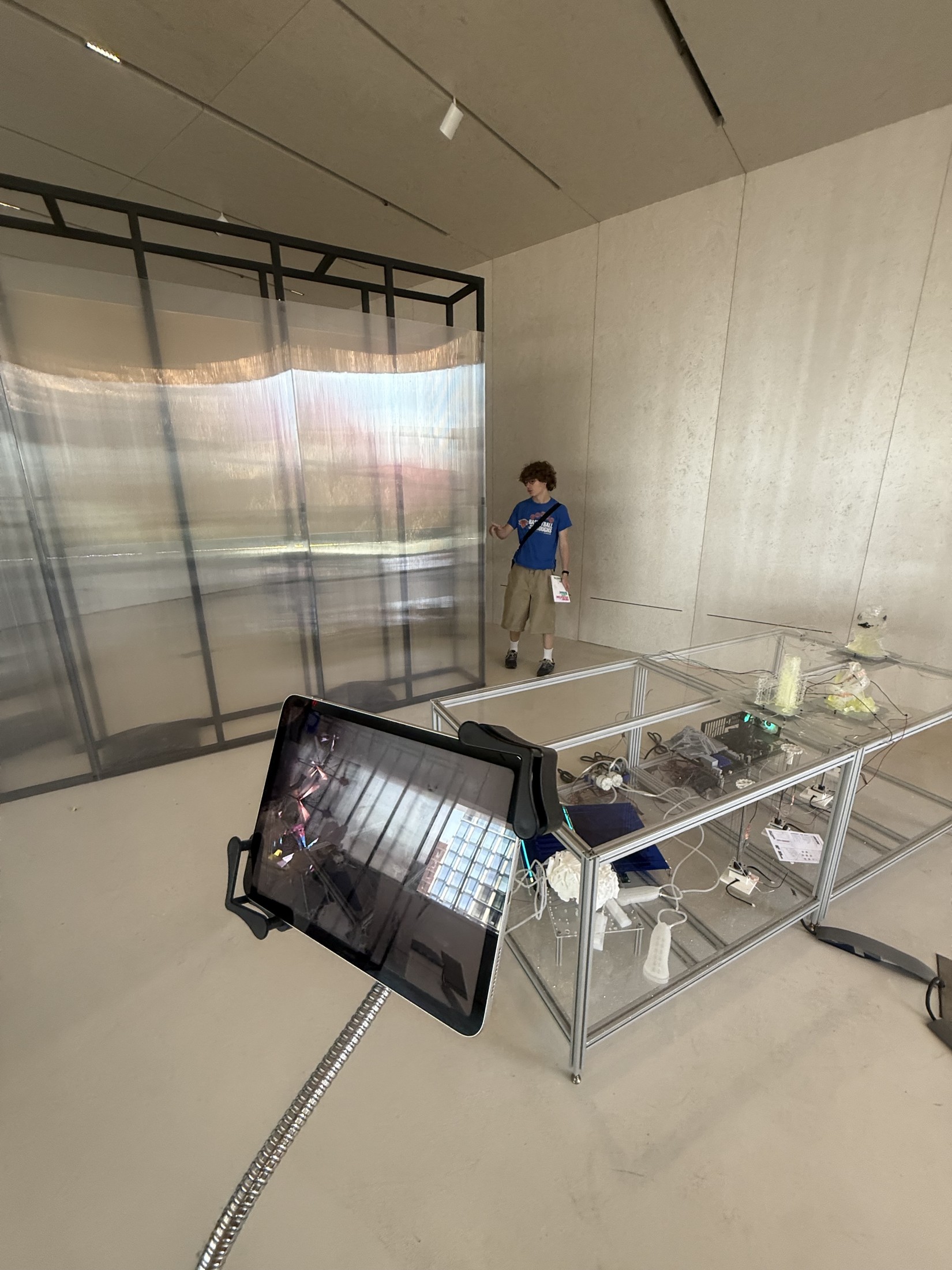
Yuri Lee, Gim Cheok (2026): a vitrine of seaweed forms met by an iPad AR overlay, the organic set against the computational.
Umber Majeed's Trans-Pakistan Zindabad puts its AR to archival work, à la Hartman. Majeed builds ceramic sculptures, video, and an AR layer out of her uncle Haroon Waheed Pirzada's travel agency, Trans-Pakistan, which he started in the 1990s to bring trekkers to Pakistan's mountains and which folded in 2005 as the War on Terror gutted the region's tourism. She revives the company as a fiction, in the register of South Asian digital kitsch, storefront signage and early-web interface, and aims it at the present: the deluxe gated communities and the corrupt developer Bahria Town remaking Lahore for wealthy émigrés. The AR supplies the part of the record the official archive never kept, summoned over a ceramic object the museum could not otherwise file. I like the side-by-side to illustrate the difference between the archive, which excludes, and the repertoire, the embodied and the performed, which carries other forms of memory. Majeed's work performs repertoire with a tablet.
Who owns the flow
The most literal living system in the show, William Takeo Eliot's Digested Objects, sets mealworms metabolising Styrofoam in an interspecies arrangement you set up and then watch.
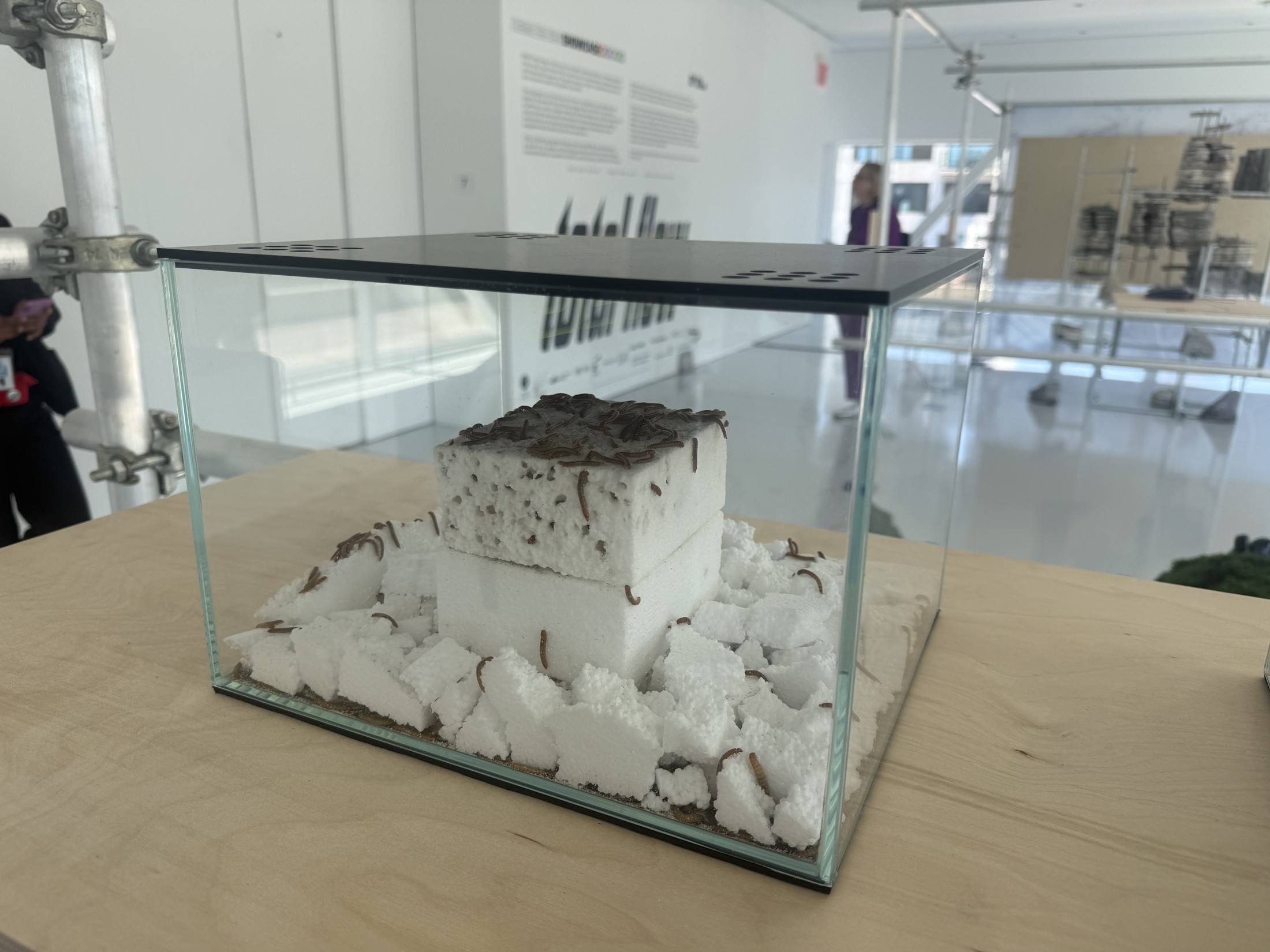
William Takeo Eliot, Digested Objects (2023): mealworms metabolising a Styrofoam block, the work the process and not a picture of it.
Eliot makes a sort of Pierre Huyghe move, conditioning a non-human process and letting it run, the work amounting to the process and not a picture of it, and it leaves authorship in a strange place; who made it, the artist or the worms? Once a show fills with works that behave as systems and performances and living processes rather than objects, the question stops asking what the work looks like and starts asking who owns the process.
Here the show and the festival downstairs turn out the same inquiry, and here I want to wire this piece to the DEMO essay I wrote on the conference, and especially to Danielle Paterson's case for the artist as an entity rather than a vendor. Holly Herndon and Mat Dryhurst have spent years on this edge; their Serpentine show The Call trained AI models on choirs and then held the output in a data trust co-owned by the singers, and through Spawning they built the only widely used consent layer for AI training data, on the premise that "all media is training data." The Call also names the right to refuse, the question of who owns the process, dressed as a choir. The works in Total Flow, I think, make the system visible; Herndon and Dryhurst remind that the system is something people not only observe and critique, but are actually implicated in.
Sources
Emily Watlington, "The 21st Century's Biggest Art Trend is Not a Style," Art in America (Jack Burnham's 1968 "Systems Esthetics"; Hans Haacke; the "mechanic vs car wash" distinction).
NEW INC; Mindy Seu, Cyberfeminism Index.
Sam Lewitt, Miguel Abreu Gallery; Whitney Independent Study Program; Maura Brewer (both ISP alumni).
Michael Fried, "Art and Objecthood," Artforum, Summer 1967; Diana Taylor, The Archive and the Repertoire.
Artists: Adam Vačkář; Aurora Mititelu; Yaloo (Ji Yeon Lim), FACT; Tess Oldfield; Umber Majeed, Pioneer Works; William Takeo Eliot / BiocraftingStudio; Yuri Lee.
Pierre Huyghe, Liminal, Punta della Dogana.
Holly Herndon & Mat Dryhurst, The Call, Serpentine; Spawning.